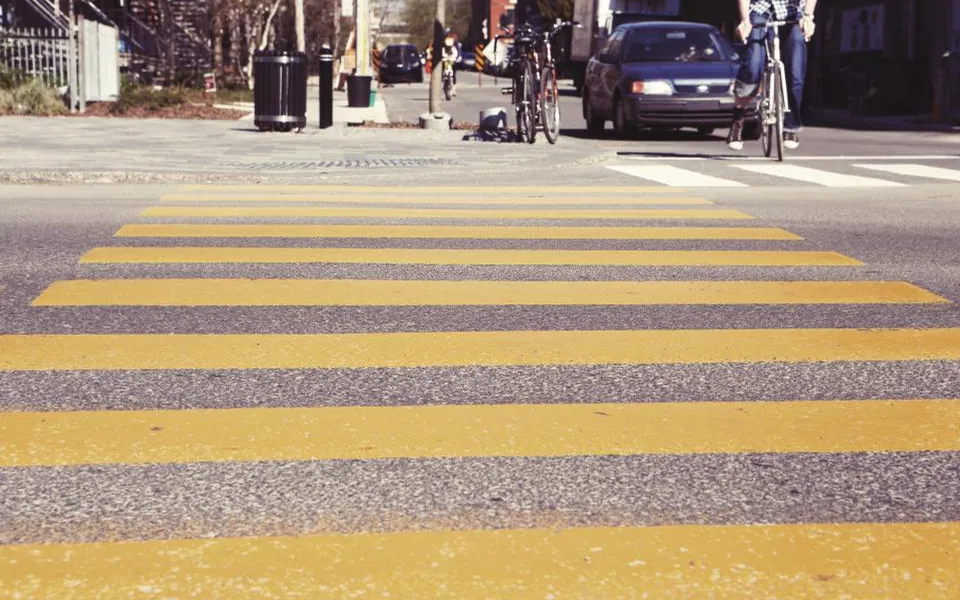
Most people are poor judges of chance, and the mistakes are consistent. At a Toronto intersection or at a table in an online casino such as SpinEmpire Casino, the gap between how risky something feels and how risky it is follows the same patterns. A quiet residential street feels safe, a busy crossing feels dangerous, and a run of red on a roulette wheel feels like a sign that black is due.
Road safety researchers and gambling researchers have been describing those patterns for decades, mostly without talking to each other. Side by side, the street shows what happens when a system is designed around human error, and the casino floor shows how arithmetic behaves when intuition is left in charge.
What the Collision Numbers Say
Driving is among the riskiest things most adults do on an ordinary day, and almost nobody experiences it that way. Transport Canada's national collision statistics for 2023 recorded 1,964 motor vehicle fatalities, the highest count in ten years, along with 9,261 serious injuries. Spread across the population, that works out to 4.9 deaths per 100,000 people.
A rate like that is small enough to disappear from daily experience. Thousands of uneventful trips teach a driver that nothing happens, and the lesson is accurate for any single trip. Over a lifetime it is wrong. Rough arithmetic makes the point: a yearly rate of 4.9 per 100,000, repeated across eight decades, adds up to odds in the region of one in 250. Few people would take that as a single bet, yet it is accepted without a second thought when it arrives in small daily instalments.
Why a Familiar Street Feels Safer Than It Is
Three habits of mind do most of the work. The first is familiarity: a route driven five hundred times stops registering as a place where anything can go wrong, which is one reason speeds creep up on residential streets.
Control is the second. Risk that feels self-managed gets discounted, and surveys of drivers going back to the early 1980s have kept finding that a large majority place themselves in the more skilled half of all drivers. The arithmetic does not allow it.
Then there is vividness. A rare, dramatic event stays in memory and is given too much weight, while the steady background toll of ordinary collisions rarely makes the news and is given too little. These are features of ordinary attention, which is why road authorities stopped relying on warnings alone.
The Same Errors at the Roulette Wheel
Move from the street to a casino game and the biases reappear in another form. Familiarity becomes the comfort of a favourite slot that seems understood after hundreds of spins. Control turns into the belief that choosing the numbers, timing the spin or switching tables changes the outcome. Vividness is the remembered win that outweighs forty forgotten losses.
The arithmetic underneath is fixed and fairly simple. A single-zero roulette wheel has 37 pockets. A bet on red covers 18 of them, so it wins 48.6 per cent of the time and loses 51.4 per cent, and because the payout is even money the house keeps an average of 2.7 per cent of everything staked. Add a second zero and the wheel has 38 pockets; the edge nearly doubles, to 5.26 per cent. Each spin is independent. Ten reds in a row leave the chance of an eleventh exactly where it started.
Slots express the same idea as return to player, or RTP. A game with a 96 per cent RTP pays back $96 of every $100 wagered when averaged over an enormous number of spins. That figure describes the long run. An evening is short, and across a few hundred spins the result can land far from the average in either direction, which is the kind of variation intuition misreads as a streak.
Careful driving does lower a driver's risk. No amount of care changes the edge built into a game of pure chance; the only things a player controls are how much is staked and for how long.
Designing for Error Instead of Lecturing About It
Modern road safety policy starts from the assumption that people will misjudge. Lower speed limits, narrower lanes, raised crossings and protected bike lanes all work without asking anyone to become a better estimator of risk, and the collision patterns on Toronto streets show where that kind of design is still missing.
Gambling has its own version of the approach, and it also works by deciding before the moment of temptation. Many regulated sites let a player set deposit limits, loss limits and session reminders ahead of time. A limit chosen in a calm moment is harder to undo when judgment later slips.
For the size of those limits, Canada's Lower-Risk Gambling Guidelines give three concrete numbers: gamble no more than 1 per cent of household income before tax per month, on no more than four days per month, and avoid regularly playing more than two types of games. The guidelines' own example is a household earning $70,000 a year, for which the monthly ceiling is $58. All three are meant to be followed together.
Two further points belong beside those figures. Gambling is restricted to adults, with the minimum age set at 18 or 19 depending on the province. And the mathematics above means that play is a cost, comparable to a concert ticket, and never a source of income; money needed for rent or transit fare has no place in it.
Where the Comparison Stops
The parallel has a limit. A person who gambles carries the financial risk personally, at least in the first instance. A driver who misjudges speed hands much of the risk to someone else: the pedestrian in the crosswalk, the cyclist at the curb, the passenger in the next car. That asymmetry is why street design is treated as a public responsibility while gambling limits remain largely individual tools.
What carries over is the habit of distrusting the feeling of safety. Checking the actual numbers, setting the limit in advance and letting the design do the remembering make sense on a residential street and at a roulette table alike.
← Back to Blog